How to Choose Flicker Free LED Lighting in 2026?

Time:2026-10-22 Author:Mason
0%

Choosing LED lighting in 2026 requires more than checking brightness, color temperature, or energy ratings. The question “what is flicker-free LED lighting” deserves a practical answer. Flicker-free lighting produces a steadier light output, reducing rapid changes that may be invisible but uncomfortable during reading, filming, or extended computer work. A lamp can appear perfectly stable to the eye and still create camera bands or visual fatigue.

Dr. Arnold Wilkins, a leading researcher in visual perception, has stated, “Flicker can be invisible, yet still biologically active.” This warning matters when comparing modern LED bulbs, panels, and office fixtures. Look for measured flicker data, not only marketing language. Useful indicators include Percent Flicker, Flicker Index, SVM, and Pst LM. IEEE 1789 guidance can also help buyers judge modulation risks at different frequencies.

Check the complete system. The LED driver, dimmer, power supply, and control method all influence performance. A high-quality bulb may flicker when paired with an incompatible dimmer. Smartphone slow-motion video can reveal obvious pulsing, but it cannot replace laboratory testing. That limitation is easy to forget.

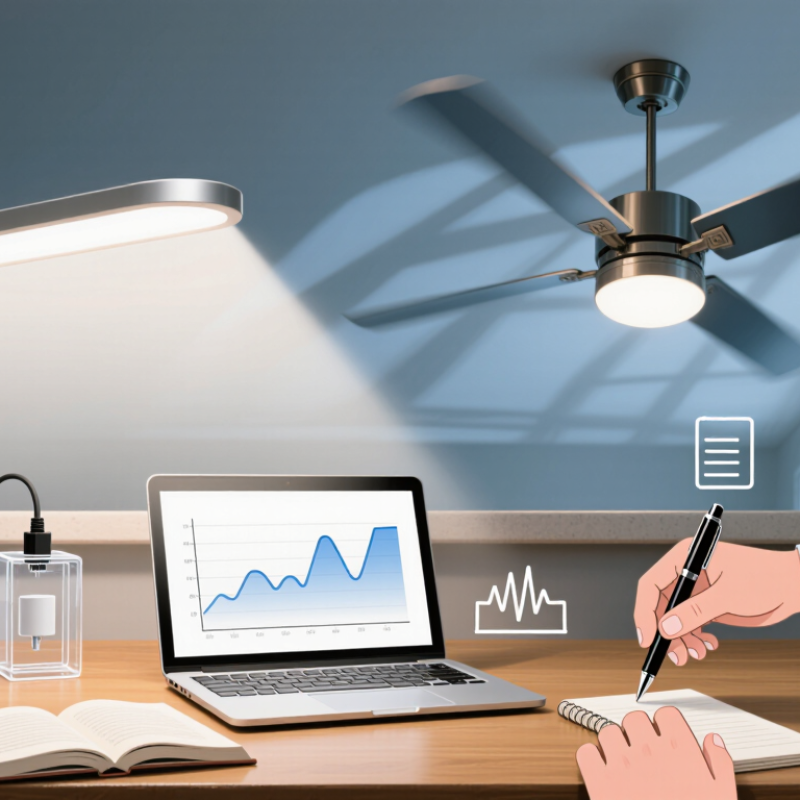
Real-world testing remains valuable. Observe the light over a desk, kitchen counter, or workshop bench. Notice shadows from moving hands. Watch a fan blade under the lamp. Small details matter.

No purchasing checklist is perfect. Specifications may be incomplete, and “flicker-free” is not always used consistently. Choose transparent manufacturers, request test reports, and compare performance at full and reduced brightness. In 2026, reliable LED selection means combining technical evidence with careful observation.
How to Choose Flicker Free LED Lighting in 2026?

What Flicker-Free LED Lighting Means in 2026

What Flicker-Free LED Lighting Means in 2026

In 2026, flicker-free LED lighting does not mean absolutely zero light variation. It means variation remains low enough to reduce visible and invisible risks during normal use. The International Commission on Illumination, in CIE TN 006:2016, identifies PstLM and SVM as useful flicker and stroboscopic-effect measurements. Many current European requirements use limits of PstLM ≤ 1.0 and SVM ≤ 0.9 for applicable lamps. These figures offer a practical reference, not a universal guarantee.

IEEE Std 1789-2015 also links modulation depth and frequency with possible health risks. Higher modulation requires higher frequency to reduce concern. Ask suppliers for measured PstLM, SVM, modulation percentage, and test frequency. “Flicker-free” alone is too vague. A lamp can look steady to your eyes while a phone camera shows dark rolling bands. I have seen this during office tests, especially with dimmed lamps and inexpensive drivers.

Check the lamp at 100%, 50%, and 10% brightness. Dimming can change the driver’s waveform. Also test beside monitors, reflective desks, and rotating fans. These details reveal stroboscopic effects that a showroom may hide. Independent laboratory results are more reliable than marketing claims, but testing methods still differ. That part deserves skepticism. Choose products with stable drivers, published measurements, suitable dimmer compatibility, and documentation aligned with CIE, IEEE, or relevant energy regulations.

How to Identify the Main Sources of LED Flicker

Choosing flicker-free LED lighting in 2026 starts with finding where the flicker begins.

The LED chip is rarely the main cause. The driver controls current, and a weak driver may produce visible or invisible brightness changes. Low-frequency ripple often follows the electrical supply cycle. Poor filtering can make this problem worse.

Dimming equipment creates another common source.

A dimmer designed for older lamps may interrupt the current unevenly. The LED can then pulse, buzz, or fail to reach its stated brightness. Pulse-width modulation can also create flicker when its frequency is too low.

Ask for the modulation frequency and flicker percentage, not only the phrase “flicker-free.”

Technical reports should identify test methods and operating conditions.

Look closely at a moving fan or rotating object.

Brightness bands may appear. A slow-motion phone video can reveal patterns, but it is not proof. Camera sensors can create false bands. I once rejected a fitting after seeing stripes on video, then found the camera caused them.

A flicker meter gives stronger evidence.

Measure at full brightness and during dimming. Test several lamps on the same circuit. Voltage changes, loose connections, and shared loads can also affect results.

Check published data against recognized photobiological and flicker guidance, such as IEEE 1789 and relevant IEC methods. Independent laboratory results deserve more confidence than vague packaging claims.

Some measurements still miss discomfort in sensitive users, so real-world observation matters. Test beside a desk, under normal working hours, not only in a showroom.

Which Flicker Metrics Matter for Health and Visual Comfort

How to Choose Flicker Free LED Lighting in 2026?

Flicker-free lighting requires more than a “flicker-free” label. Check percent flicker, modulation depth, flicker index, frequency, PstLM, and SVM. These metrics describe different visual risks. Percent flicker shows waveform variation, while flicker index considers the waveform’s distribution over time. A lamp may show a low average variation but still produce sharp peaks.

The CIE Technical Note 006:2016 identifies PstLM and SVM as useful measures for temporal light modulation. PstLM equals 1 as a reference level for visible short-term flicker. SVM equals 1 represents a reference level for stroboscopic visibility. These are not complete health guarantees. IEEE 1789-2015 also links modulation percentage with operating frequency and recommends evaluating both, rather than trusting frequency alone. Higher frequency helps, but it does not automatically remove discomfort.

Look for test reports at full output and during dimming. That is where weak drivers often reveal themselves. Use a phone camera as a quick check; rolling dark bands can expose modulation, although cameras are not laboratory instruments. In offices, classrooms, or workshops, compare PstLM and SVM results under realistic dimming levels. I still treat one impressive number with suspicion. Lighting behavior changes with controls, temperature, and electrical load. Ask for the measurement method, test conditions, and waveform data before choosing a 2026 LED fitting.

How to Choose Flicker-Free LED Lighting in 2026?

Which Flicker Metrics Matter for Health and Visual Comfort?

Illustrative 100 Hz LED Light Output Waveform
Lower modulation generally means less visible flicker and lower risk of stroboscopic effects.
Percent Flicker

(Lmax − Lmin) ÷ (Lmax + Lmin). It describes the relative amplitude of light modulation.

Flicker Index

The area below the average light level divided by the total area between the waveform and its minimum level.

PstLM and SVM

Frequency-weighted metrics used to assess short-term visible flicker and stroboscopic effects. Lower values are preferable.

When comparing LED lighting, do not rely on “flicker-free” wording alone. Request test results that include percent flicker, flicker index, PstLM and SVM across the intended dimming range. A 100 Hz waveform is used here because twice-the-mains-frequency modulation is common in inadequately smoothed LED drivers. Individual sensitivity varies, so lower modulation and stable performance during dimming are the safer choice for visual comfort.

The plotted curves are calculated examples using sinusoidal light modulation: 1% and 10% modulation at 100 Hz. They illustrate the effect of modulation depth and are not measurements of a specific product.

How to Compare LED Bulbs, Panels, and Smart Lighting Systems

How to Choose Flicker Free LED Lighting in 2026?

Comparing bulbs, panels, and smart lighting systems requires more than reading “flicker-free” on a package. I test lights with a flicker meter, then repeat measurements at full, half, and minimum brightness. IEEE 1789 recommends keeping modulation below 2.5% at 100 Hz for the lower-risk zone. Many inexpensive products exceed that level when dimmed.

LED bulbs are easy to replace, but their compact drivers can struggle with older dimmers. Panels usually spread light more evenly across a desk, yet their remote drivers may create visible flicker during low-output operation. Smart systems add another variable: wireless controls, software dimming, and pulse-width modulation can change performance after installation. Check measured PstLM and SVM values, not only marketing language. European lighting guidance commonly references PstLM below 1.0 and SVM below 0.4, based on IEC measurement methods.

Look for independent laboratory reports using IEC 61547-1 procedures. The U.S. Department of Energy’s solid-state lighting research also treats temporal light modulation as a critical quality issue. In a home office, I would compare a bulb beside a panel using a slow-motion phone recording, then confirm results with a meter. That method is imperfect. Phone cameras miss some frequencies. Still, it exposes obvious pulsing. Choose the system that stays stable while dimmed, not merely the brightest option.

How to Choose Flicker-Free LED Lighting in 2026? — Comparing LED Bulbs, Panels, and Smart Lighting Systems

Values are typical market ranges or selection guidance rather than universal specifications. Confirm the exact product performance from independent test reports measured at the intended dimmer, driver, and operating condition.
Comparison Dimension LED Bulbs LED Panels Smart Lighting Systems What to Check Before Purchase Practical Recommendation
Typical Power Range 4–15 W for household replacement bulbs. 25–60 W for common 600 × 600 mm ceiling panels. 5–15 W per smart bulb; complete systems vary by fixture and controller. Compare delivered lumens, not wattage alone. Choose the lowest power that provides the required maintained illuminance and light distribution.
Typical Light Output 450–1,600 lm, depending on bulb size and design. 3,000–6,000 lm for common commercial and office panels. 450–1,600 lm per bulb; output may decrease at very warm color settings. Look for measured lumens at the selected color temperature and operating mode. For work areas, verify the installed layout with a lighting calculation rather than relying only on lumens per fixture.
Typical Efficacy Approximately 80–120 lm/W. Approximately 90–140 lm/W, depending on optics and driver efficiency. Approximately 60–110 lm/W; wireless electronics and tunable color can reduce efficacy. Check whether the figure includes the driver, diffuser, and control electronics. For energy-focused projects, compare system efficacy at the actual programmed setting.
Flicker Risk Highly dependent on the internal driver and dimming method; low-cost products may show visible or stroboscopic flicker. Usually determined by the external driver; poor driver compatibility can cause flicker during dimming. May flicker during wireless commands, color transitions, low-level dimming, or incompatible control settings. Request measured percent flicker and flicker index across the full dimming range, not only at 100% output. Prefer products with independent waveform measurements and stable performance at both full and reduced output.
Flicker Measurement Useful data includes modulation depth, flicker frequency, percent flicker, and flicker index. Evaluate the complete panel-and-driver combination. Test steady-state, minimum dim level, color changes, and network-controlled transitions. Measurements should identify the test voltage, frequency, dimming level, and instrument or method used. Do not treat “flicker-free” marketing language as a substitute for quantitative test data.
High-Frequency Performance Some drivers use high-frequency switching to reduce visible modulation; actual performance varies. Quality constant-current drivers can provide stable output, but the panel itself does not guarantee low flicker. Electronic control stages can introduce additional modulation during dimming or color tuning. Check whether the modulation frequency remains stable and whether low-frequency components are present. For cameras, rotating machinery, or precision work, require a measured waveform under the actual operating setup.
Dimming Compatibility May support phase-cut, 0–10 V, or no dimming, depending on the model. Often uses 0–10 V, DALI, digital control, or a non-dimmable driver. Usually supports app, remote, voice, or gateway control; compatibility depends on the ecosystem. Confirm minimum load, dimmer type, neutral-wire requirements, and low-end dimming stability. Use a driver and controller designed as one tested system whenever possible.
Color Rendering CRI 80+ is common; CRI 90+ is available for higher-quality residential lighting. CRI 80+ is common; CRI 90+ is preferred where color accuracy matters. Often CRI 80–95, but performance can change between white and saturated color modes. Check CRI or TM-30 results, especially R9 performance for reds. Use CRI 90+ or strong TM-30 results for retail, art, healthcare, food, and detailed visual tasks.
Color Temperature Common fixed options: 2,700 K, 3,000 K, 4,000 K, and 5,000 K. Common options: 3,000–6,500 K; some fixtures are tunable white. Often adjustable from approximately 2,200–6,500 K, with RGB or RGBW options in some systems. Verify the actual CCT range, color consistency, and output at each setting. Use warmer settings for relaxation and neutral settings around 3,500–4,000 K for many workspaces.
Lifetime Rating Typically 15,000–25,000 hours for general-purpose products. Typically 30,000–60,000 hours, depending on thermal design and driver quality. Typically 15,000–25,000 hours for bulbs; electronics and controls may have separate service lives. Look for L70 or L90 information, ambient-temperature conditions, and warranty terms. Prioritize thermal management and replaceable drivers in high-use commercial installations.
Thermal Management Small enclosures can retain heat, especially in enclosed fixtures. Large heat-spreading surfaces generally improve cooling, but ceiling void temperature matters. Wireless components and compact housings add heat sources inside the product. Check whether the product is approved for enclosed fixtures or high-ambient locations. Allow ventilation and avoid installing products outside their rated ambient-temperature range.
Controls and Connectivity Usually simple on/off or wall-dimmer control. Often centralized control through wired building systems. May use Bluetooth, Wi-Fi, Thread, Zigbee, Matter, or proprietary control methods. Check local control, internet dependence, firmware support, interoperability, and cybersecurity requirements. For critical lighting, ensure basic manual control remains available if the network or cloud service fails.
Best-Fit Applications Homes, hospitality rooms, decorative fixtures, and retrofit projects. Offices, classrooms, retail areas, healthcare spaces, and uniform ceiling grids. Homes, hotels, meeting rooms, wellness spaces, and installations needing scenes or scheduling. Assess ceiling height, visual tasks, occupancy, maintenance access, and control requirements. Select the form factor based on the lighting task first, then optimize flicker, efficiency, and controls.
Camera and Video Suitability Must be tested at the intended shutter speeds and dimming levels. Often suitable when the driver has stable output, but camera testing is still recommended. Color changes and low dimming levels can create visible banding or rolling-shutter artifacts. Test with the actual camera, frame rate, shutter angle, and lighting scene. For filming or broadcasting, specify a measured flicker performance requirement instead of relying on product claims.
Safety and Compliance Check electrical safety, electromagnetic compatibility, photobiological safety, and regional efficiency requirements. Check fixture, driver, emergency-lighting, and ceiling-system requirements. Check radio compliance, electrical safety, data privacy, and controller interoperability. Use recognized laboratory reports and installation instructions applicable to the target country. Purchase only products with clearly documented ratings and installation conditions.
2026 Buying Priority Measured low-flicker performance, dimmer compatibility, CRI, and thermal suitability. Driver quality, complete-system flicker data, maintained lumens, and control compatibility. Stable dimming, local fallback control, interoperability, software support, and measured color-mode performance. Compare equivalent test conditions and total ownership cost, including controls and maintenance. Choose documented performance over the lowest purchase price or an unverified “flicker-free” label.

How to Verify Flicker-Free Performance Before Buying

Choosing LED lighting in 2026 means testing performance, not trusting “flicker-free” printed on a box. In real installations, flicker can change with dimming, unstable voltage, or a low-quality control system. Ask the seller for laboratory data at full brightness and every intended dimming level. Look for measured modulation depth, flicker index, and frequency. Pst LM and SVM results are also useful professional indicators. A product may appear steady to your eyes yet create camera banding or discomfort during long desk work.

Tips: Request the actual test report, not a marketing certificate. Confirm the test method, electrical conditions, and measurement distance. Use slow-motion phone video only as a screening tool; it cannot prove comfort or performance. Test the lamp with your home's voltage and dimmer. If possible, borrow one for an evening. Watch white walls, rotating fans, and phone screens. Ask whether performance changes after warming for thirty minutes. Short checks miss problems.

For stronger verification, choose products tested by an independent laboratory using recognized guidance, such as IEEE 1789 and relevant IEC methods. These references support informed decisions, but they do not make every installation risk-free. Read the limits carefully. Human sensitivity varies, and published numbers are not the whole experience. My own mistake was testing only at full output; the lamp became visibly unstable near its lowest setting. That result changed my buying checklist. Test the complete system, not just the bulb.

FAQS

What usually causes flicker in LED lighting?

The driver often causes flicker, not the LED chip. Weak filtering can create brightness changes. Low-frequency ripple may follow the electrical supply cycle.

Can an older dimmer make LED lights flicker?

Yes. Older dimmers may interrupt current unevenly. The light can pulse, buzz, or lose brightness. Test the lamp at full and low output.

Which flicker measurements should I check?

Check percent flicker, modulation depth, flicker index, frequency, PstLM, and SVM. Each metric describes a different lighting behavior. One number is not enough.

Does a higher frequency always remove flicker discomfort?

No. Higher frequency can reduce visible pulsing, but it does not guarantee comfort. Waveform shape, modulation depth, temperature, and dimming also matter.

Can a phone camera detect LED flicker?

A slow-motion phone video can reveal dark bands or pulsing. It is only a quick check. Camera sensors can create false patterns.

How can I test a light more reliably?

Use a flicker meter at full, half, and minimum brightness. Test several lights on the same circuit. Also check voltage changes and shared electrical loads.

Are LED panels better than LED bulbs for flicker control?

Not automatically. Panels may spread light evenly, while remote drivers can flicker during dimming. Compact bulb drivers may struggle with older dimmers.

What should I request from a lighting supplier?

Request independent test results, measurement methods, operating conditions, waveform data, PstLM, and SVM values. Ask for results during dimming. Vague packaging claims are weak evidence.

How should I judge lighting comfort in a real room?

Test beside a desk during normal working hours. Watch moving fans or rotating objects for brightness bands. Compare lights at realistic dimming levels.

Can flicker measurements guarantee health and visual comfort?

No measurement provides a complete guarantee. Sensitive users may still feel discomfort. My own quick tests can miss problems, so real-world observation remains important.

Conclusion

Choosing flicker-free LED lighting in 2026 requires more than trusting a product label. What is flicker-free LED lighting? It refers to lighting designed to minimize rapid changes in brightness that may affect visual comfort, concentration, or sensitive users. Flicker can originate from the power supply, dimming circuits, incompatible controls, poor thermal design, or unstable smart-lighting components. Understanding these sources helps buyers evaluate lighting more accurately.

Important performance indicators include flicker percentage, modulation depth, flicker frequency, and short-term light modulation. These measurements can reveal problems that may not be visible to the naked eye. When comparing LED bulbs, panels, and smart systems, consider brightness stability, dimmer compatibility, color consistency, and performance across different settings. Before buying, review independent test data, technical specifications, and results taken at multiple brightness levels. If possible, test the light through a slow-motion camera or specialized flicker meter, while remembering that camera results are only a preliminary reference.

Mason

Mason

Mason is a seasoned marketing professional with a deep expertise in the company's offerings and a passion for driving brand awareness. With a strong background in digital marketing strategies, he has an innate ability to connect with diverse audiences and effectively communicate product benefits.......