2026 Best LED Panel vs LED Downlight What Is the Difference?

Time:2026-10-05 Author:Amelia
0%

Choosing the right ceiling light begins with understanding what is the difference between LED panel and LED downlight. These fixtures may use similar LED technology, but they create very different lighting experiences. An LED panel spreads soft, even illumination across a broad surface. It often suits offices, classrooms, clinics, and retail aisles. An LED downlight concentrates light through a smaller aperture. It creates clearer pools of brightness on desks, counters, artwork, or walkways.

Lighting expert James R. Benya has said, “Light should support the task, not compete with it.” That principle matters during real installations. A panel can reduce harsh shadows beneath a low office ceiling. A downlight can add visual focus above a dining table. However, the wrong beam angle may produce bright circles, dark gaps, or uncomfortable glare. I have seen attractive downlights fail when their spacing ignored the ceiling height.

This comparison will examine brightness, beam distribution, glare, color quality, energy use, installation effort, and long-term maintenance. It will also consider room purpose, ceiling structure, and user comfort. A 600×600-millimeter panel may look efficient on a ceiling plan, yet feel flat in a hospitality setting. A compact downlight may appear elegant, yet require more careful positioning. The distinction is not always clean. Some modern products overlap. Therefore, the best choice depends on how people use the room, not only on wattage or appearance. Small details matter. A reliable decision balances measurable performance with the lived experience beneath the light.
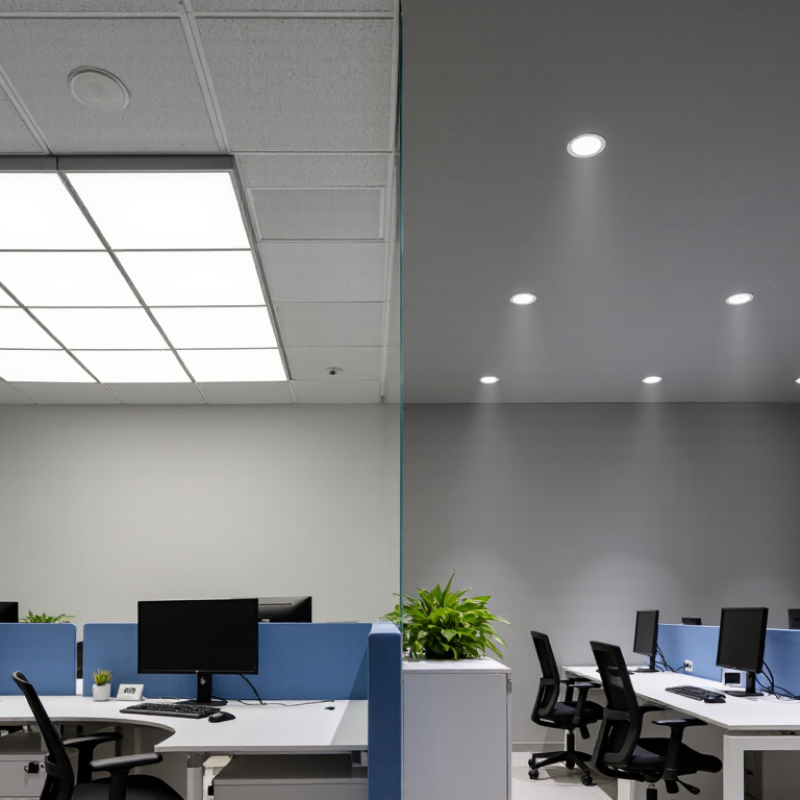
2026 Best LED Panel vs LED Downlight What Is the Difference?

What Are LED Panels and LED Downlights?

LED panels and LED downlights are both efficient ceiling lights, but they serve different lighting purposes. An LED panel has a broad, flat surface that spreads light evenly across offices, classrooms, kitchens, and other large areas. Its soft output can reduce harsh shadows on desks and floors. Most panels fit suspended, recessed, or surface-mounted ceilings. Check the panel’s size, color temperature, glare rating, and driver quality before installation. A poor driver may cause flicker, even when the light appears bright.

LED downlights are compact fixtures placed inside ceiling cutouts. They direct light downward, making them useful for hallways, bedrooms, bathrooms, and display areas. Their beam angle shapes the result. A narrow beam highlights a table or wall, while a wider beam creates more general illumination. During real installations, ceiling depth matters. Some downlights need extra space for heat dissipation, and insulation must not block approved ventilation areas. Measure twice.

Panels usually create more uniform coverage. Downlights offer greater control and a cleaner spotlight effect. I once assumed brighter fixtures always worked better, but that choice produced glare and uncomfortable reflections. Wattage alone is not enough. Compare lumens, beam angle, color rendering, dimming compatibility, and expected operating hours. Moisture-rated fixtures are necessary in damp locations. Even experienced installers can overlook the switch and driver compatibility, so testing one fitting before ordering many is a sensible safeguard.

How Do LED Panels and LED Downlights Differ?

LED panels and LED downlights differ mainly in shape, light distribution, and installation method. Panels produce broad, even illumination across desks, classrooms, and retail areas. Their flat surface reduces harsh shadows when mounted in a grid ceiling. Downlights create focused beams from circular or square fittings. They suit corridors, kitchens, bathrooms, and areas needing targeted light.

A panel usually needs a larger ceiling opening and enough space for its driver. A downlight often fits a smaller cutout, but its spring clips need secure ceiling material. Check the ceiling depth before ordering. I have seen shallow ceilings force an unexpected redesign. That mistake is easy to avoid.

Panels can deliver comfortable uniform light, especially with a wide beam angle and low glare rating. Downlights offer more flexibility for accent lighting and room zoning. However, closely spaced downlights may create bright spots and darker gaps. Choose color temperature carefully. Neutral white often supports work areas, while warmer light feels calmer in homes. Moisture-rated fittings are important in damp locations, but ratings must match actual installation conditions. Energy savings also depend on operating hours, controls, and driver quality. A high-wattage fitting is not automatically better. Check lumens, beam angle, color rendering, and warranty terms instead of judging brightness by appearance alone.

Which Lighting Type Fits Each Room and Ceiling Design?

Choosing between an LED panel and an LED downlight depends more on the room and ceiling than on wattage. LED panels spread light across a broad surface, making them suitable for offices, classrooms, kitchens, and low ceilings. They reduce harsh shadows and support even desk illumination. The U.S. Department of Energy reports that LED lighting uses at least 75% less energy and can last up to 25 times longer than incandescent lighting. However, a large panel may feel visually flat or too clinical in a residential room.

LED downlights suit bedrooms, corridors, bathrooms, retail areas, and ceilings with decorative details. Their recessed form keeps the ceiling clean, while adjustable versions can highlight artwork or kitchen worktops. Vaulted ceilings often benefit from directional downlights, although poor spacing can create dark corners and scalloped walls. The Illuminating Engineering Society recommends evaluating illuminance, glare, colour quality, and viewing tasks rather than choosing fixtures by lumens alone. A useful detail is colour rendering: high-CRI lighting generally reveals food, timber, and fabrics more naturally. Not always necessary.

The International Energy Agency reported that LEDs represented more than half of global lighting sales in 2022, showing their growing role in efficient lighting design. Still, efficiency does not guarantee comfort. I would use panels for broad, functional light and downlights for controlled, layered light. The better solution may combine both, especially where ceilings change height or rooms serve several purposes.

2026 Best LED Panel vs LED Downlight: What Is the Difference? — Which Lighting Type Fits Each Room and Ceiling Design?

Comparison Dimension LED Panel LED Downlight Practical Selection Guidance
Basic lighting concept A broad, flat luminous surface designed to illuminate a large area evenly. A compact recessed or surface-mounted fixture that directs light from a smaller aperture. Choose panels for uniform general lighting and downlights for focused, layered, or decorative lighting.
Typical wattage range Approximately 24–60 W for common 300 × 600 mm, 600 × 600 mm, or 300 × 1200 mm formats. Approximately 5–25 W per fixture, depending on aperture size, output, trim, and beam angle. Compare total installed wattage, not only the wattage of one fixture.
Typical luminous efficacy About 80–120 lm/W for many general-purpose products. About 70–110 lm/W for many general-purpose products; performance varies with optics and thermal design. Use verified lumens and efficacy figures from the product specification when calculating energy use.
Light distribution Usually wide and diffuse, commonly around 100–120°. Usually controlled and directional, commonly around 24–100° depending on the reflector or lens. Wide distribution suits open work areas; narrower beams help accent walls, counters, artwork, or displays.
Illumination uniformity Generally high when fixtures are spaced correctly across the ceiling. Can create brighter and darker zones if spacing, beam angle, or mounting height is unsuitable. For desks, classrooms, and offices, panels often simplify uniform lighting calculations.
Glare control Large diffusing surfaces can reduce harsh point-source glare; UGR performance depends on optics and installation. Deep-set, baffled, or well-shielded designs can control glare, while exposed bright apertures may cause discomfort. Check the actual UGR rating and viewing angle rather than judging glare only by fixture type.
Common color temperatures Typically 3000 K, 4000 K, and 5000–6500 K. Typically 2700–3000 K, 3500–4000 K, and 5000–6500 K. Use warmer light for relaxation areas and neutral white for work-focused spaces.
Color rendering Commonly CRI 80 or higher; higher-CRI versions are available. Commonly CRI 80 or higher; CRI 90 or higher is preferable for retail, hospitality, kitchens, and artwork. Select a verified CRI value when accurate color appearance matters.
Typical rated life Often 25,000–50,000 hours, depending on driver quality, temperature, and operating conditions. Often 25,000–50,000 hours under stated operating conditions. Rated life is not a guarantee; thermal management and driver reliability strongly affect service life.
Best ceiling compatibility Suspended grid ceilings, plasterboard ceilings with suitable cut-outs, and surface-mounted ceiling systems. Plasterboard, gypsum, timber, concrete with appropriate installation methods, and shallow ceiling systems. Confirm cut-out diameter, fixture depth, driver space, and ceiling structure before installation.
Required ceiling depth Usually requires a shallow panel body or sufficient void space for the panel and driver. Requires enough recessed depth for the housing and driver; slim models are available for limited voids. Measure the ceiling cavity before choosing a recessed fixture.
Installation and layout Fewer larger fixtures can cover a broad area, making layout relatively simple. Requires careful spacing, alignment, beam selection, and coordination with ceiling joists or services. Panels reduce the number of ceiling openings; downlights offer more layout flexibility.
Maintenance access Accessible in suspended ceilings; recessed and surface-mounted versions may require fixture removal. Usually accessible from below, but the driver may need separate access depending on the design. For commercial spaces, consider driver replacement access and spare fixture availability.
Visual appearance Clean, architectural, and generally minimal when aligned with ceiling modules. Discrete and flexible, with trim colors, shapes, gimbal options, and adjustable versions. Panels suit modern uniform ceilings; downlights suit layered and detail-oriented interiors.
Dimming and controls Dimmable versions may support 0–10 V, DALI, phase-cut, or other control systems. Dimmable versions may support phase-cut, 0–10 V, DALI, or other control systems. Confirm compatibility among the fixture, driver, dimmer, sensors, and control protocol.
Moisture suitability Indoor dry-area models are common; damp-location versions must have an appropriate IP rating. Damp-rated models are widely available for bathrooms and covered outdoor areas. Select the IP rating according to the location and local electrical requirements.
Primary strengths Even illumination, clean appearance, efficient coverage, and suitability for modular ceilings. Directional control, design flexibility, zoning, accent lighting, and compatibility with many residential ceilings. Use the lighting type that matches the room’s visual task and ceiling construction.
Primary limitations May look too uniform in decorative interiors and may require larger ceiling modules or suitable support. Poor spacing can cause scalloping, glare, shadows, or uneven brightness. A lighting plan is important, especially when several downlights are used.

Recommended Lighting Type by Room and Ceiling Design

Room or Ceiling Condition Preferred Option Why It Fits Useful Design Notes
Office with a suspended grid ceiling LED Panel Fits common ceiling modules and provides broad, uniform illumination for desks and circulation areas. Consider low-glare optics and neutral white light around 3500–4000 K.
Classroom or training room LED Panel Supports even light levels across desks, boards, and circulation paths. Use glare-controlled products and separate switching or dimming zones where possible.
Living room with a decorative ceiling LED Downlight Allows ambient, accent, and wall-washing layers without visually filling the entire ceiling. Use warm white light around 2700–3000 K and dimming for flexibility.
Bedroom with a low ceiling Slim LED Downlight or Surface Panel Shallow fixtures reduce visual bulk and can provide comfortable general lighting. Avoid high-glare point sources directly above the bed; choose warm, dimmable lighting.
Kitchen with worktops and cabinets LED Downlight plus task lighting Directional light can illuminate work zones, while under-cabinet lighting reduces countertop shadows. Use a wider beam for general light and higher color rendering for food preparation.
Bathroom or shower room Damp-rated LED Downlight Compact recessed fixtures work well in limited ceiling areas and can provide focused lighting. Select the required IP rating, follow electrical-zone rules, and use suitable mirror lighting.
Retail or showroom LED Downlight Adjustable beams and higher color rendering help highlight merchandise and display areas. Combine ambient illumination with accent beams; verify color consistency between fixtures.
Hospital corridor or healthcare support area LED Panel or controlled Downlight Panels provide uniformity, while selected downlights can suit narrow corridors and zoning requirements. Prioritize glare control, cleanability, emergency-lighting integration, and applicable regulations.
Open-plan commercial space LED Panel with control zoning Provides consistent general illumination over large areas and supports sensor-based control. Divide fixtures into daylight, occupancy, and task zones to reduce unnecessary energy use.
Concrete ceiling with limited void space Surface-mounted Panel or suitable Surface Downlight Avoids deep recessed installation where the structure does not provide enough cavity depth. Check surface mounting hardware, driver concealment, and structural fixing requirements.
Small room requiring flexible furniture layouts LED Panel Broad distribution remains useful when desks, tables, or furniture are rearranged. Use a suitable panel size and position fixtures to avoid excessive shadowing near walls.
Selection reminder: Actual performance depends on lumens, beam angle, optical design, color quality, driver efficiency, thermal management, ceiling height, spacing, and local electrical requirements. Always verify the product specification and prepare a lighting layout before installation.

What Factors Affect Their Energy Use, Lifespan, and Maintenance?

2026 Best LED Panel vs LED Downlight: What Is the Difference?

Energy use depends more on delivered lumens than fixture shape. A panel spreads light across a broad ceiling area, while a downlight concentrates it downward. In practice, a 40-watt panel may replace several inefficient fittings, but a poorly aimed downlight can create dark corners and waste output. The U.S. Department of Energy reports that LED lighting can use up to 75% less energy and last up to 25 times longer than incandescent lighting. However, this benchmark is not a direct panel-versus-downlight comparison.

Thermal design strongly affects lifespan. Panels need space behind the diffuser, while recessed downlights may trap heat above the ceiling. High temperatures accelerate driver and LED degradation. Rated life often means L70, when light output reaches 70% of its initial level. It does not mean failure-free operation. Controls also matter. Occupancy sensors, daylight dimming, and suitable drivers can reduce operating hours, although actual savings vary by room use. The DOE Solid-State Lighting R&D Opportunities report emphasizes efficacy, thermal management, and controls as major performance factors.

Tips: Choose lumens first, then watts. Check L70 data and driver access. Keep diffusers clean; dust reduces useful light. Match dimmers carefully. A cheaper fixture may become expensive after repeated ceiling access. The comparison is not perfectly clean. Installation quality often decides the real result.

How to Choose the Best LED Panel or Downlight in 2026?

Choosing the Best LED Panel or Downlight in 2026

The right fixture depends on the room, ceiling, and lighting purpose. LED panels create broad, even light across offices, classrooms, and workrooms. Their flat shape suits shallow ceilings and grid systems. Downlights produce focused beams, making them useful for kitchens, corridors, display areas, and layered home lighting. In site inspections, I check the ceiling depth before comparing wattage. A beautiful fitting is useless if installation space is too limited.

Compare more than brightness. Check lumens, beam angle, color temperature, color rendering index, glare control, and expected lifetime. Neutral white light around 3500K to 4500K often suits work areas. Warmer light can feel calmer in bedrooms and lounges. High color rendering helps food, fabrics, and artwork look more natural. A higher lumen rating is not always better. Excessive brightness can create reflections on monitors and uncomfortable shadows.

Installation conditions matter too. Confirm the cutout size, driver access, dimming compatibility, and ventilation requirements. Use products with clear testing documents and appropriate electrical certifications for your region. A qualified installer should verify wiring and ceiling safety. I once selected a powerful downlight for a narrow hallway, then noticed harsh pools of light on the floor. The specification looked excellent, but the spacing was wrong. Measure the room, sketch the beam pattern, and test one fitting before ordering many. Small mistakes become expensive.

FAQS

What is the main difference between LED panels and LED downlights?

LED panels spread soft, even light across broad ceilings. Downlights direct narrower beams downward. Panels suit offices and classrooms. Downlights suit hallways and display areas.

Which fixture works better for a large room?

LED panels usually provide more uniform coverage. They can reduce harsh shadows on desks and floors. Check glare control before installation. Brightness alone can mislead.

When are LED downlights a better choice?

Downlights work well in bedrooms, bathrooms, corridors, and display areas. Their beam angle controls the effect. Narrow beams highlight objects. Wider beams provide general illumination.

How should I compare energy use?

Compare delivered lumens, not wattage alone. A suitable panel may replace several inefficient fittings. Poorly aimed downlights can leave dark corners. That wastes useful light.

What affects LED fixture lifespan?

Heat, driver quality, operating hours, and ventilation strongly affect lifespan. Recessed downlights may trap heat above ceilings. Panels also need space behind their diffusers. Rated life often means reduced output, not perfect operation.

Can lighting controls reduce electricity use?

Occupancy sensors and daylight dimming can reduce operating hours. Savings depend on room use. Check driver and dimmer compatibility carefully. Controls are not automatically compatible.

What should I check before installing a downlight?

Measure ceiling depth and the cutout size. Confirm ventilation and insulation requirements. Keep approved airflow areas clear. Measure twice.

What color temperature and rendering level should I choose?

Neutral white light around 3500K to 4500K often suits work areas. Warmer light can feel calmer in bedrooms. High color rendering helps food, fabrics, and artwork look natural.

How can I avoid glare and uneven lighting?

Sketch the beam pattern and check fixture spacing. Consider screens, shiny floors, and wall reflections. A powerful downlight can create harsh light pools. I once overlooked spacing. The specifications looked excellent, but the room felt uncomfortable.

Should I test one fitting before ordering many?

Yes. Test one fitting for brightness, glare, color, dimming, and reflections. Also check driver noise or flicker. A small trial can prevent expensive ceiling changes. It is not foolproof.

Conclusion

In 2026, choosing between an LED panel and an LED downlight depends on the room, ceiling structure, lighting goals, and long-term operating costs. An LED panel usually provides broad, even illumination across a larger surface, making it suitable for offices, classrooms, kitchens, and other areas that need comfortable general lighting. An LED downlight offers more focused, directional light and a cleaner recessed appearance, which works well in living rooms, hallways, bedrooms, retail spaces, and areas that benefit from accent or task lighting. Understanding what is the difference between LED panel and LED downlight helps users select the right solution for both appearance and performance.

Energy efficiency, LED quality, heat management, brightness, color temperature, installation method, and expected operating hours all affect lifespan and maintenance. When choosing the best option, consider ceiling depth, room size, glare control, dimming needs, beam angle, color rendering, warranty terms, and ease of replacement. A carefully matched fixture can improve visual comfort, reduce energy consumption, and deliver reliable illumination for years.

Amelia

Amelia

Amelia is a seasoned marketing professional with a wealth of expertise in our company’s core offerings. With an unwavering passion for driving growth and innovation, she plays a pivotal role in shaping our marketing strategies and enhancing brand visibility. A key aspect of her responsibilities......