When people ask why LED lights are better than halogen lamps, they usually mean more than lower electricity bills. The real comparison includes heat, service life, light quality, installation, and everyday safety. An LED bulb can illuminate a kitchen counter while using far less power than a similar halogen bulb. That difference matters in homes, shops, workshops, and vehicles where lights operate for many hours.
From practical testing and manufacturer specifications, LEDs commonly last much longer than halogen lamps. Many rated LED products reach 15,000 to 50,000 hours, while halogen lamps often last about 1,000 hours. LEDs also release less heat into the room. Touch a halogen fitting after use, and the warning is immediate. Lower heat can reduce cooling demand and protect nearby fittings, though poor ventilation can still shorten LED life. Quality varies. Cheap models may flicker, fail early, or display colors inaccurately.
Color temperature and color-rendering performance deserve attention. A warm LED may feel comfortable in a bedroom, while high-CRI models can show food and fabrics more naturally. Halogen still produces familiar, accurate-looking light, and some users prefer its instant, smooth dimming. Therefore, the best choice depends on the fitting, dimmer, climate, budget, and intended atmosphere. Evidence matters. This guide examines the trade-offs clearly, so efficiency does not replace informed judgment.
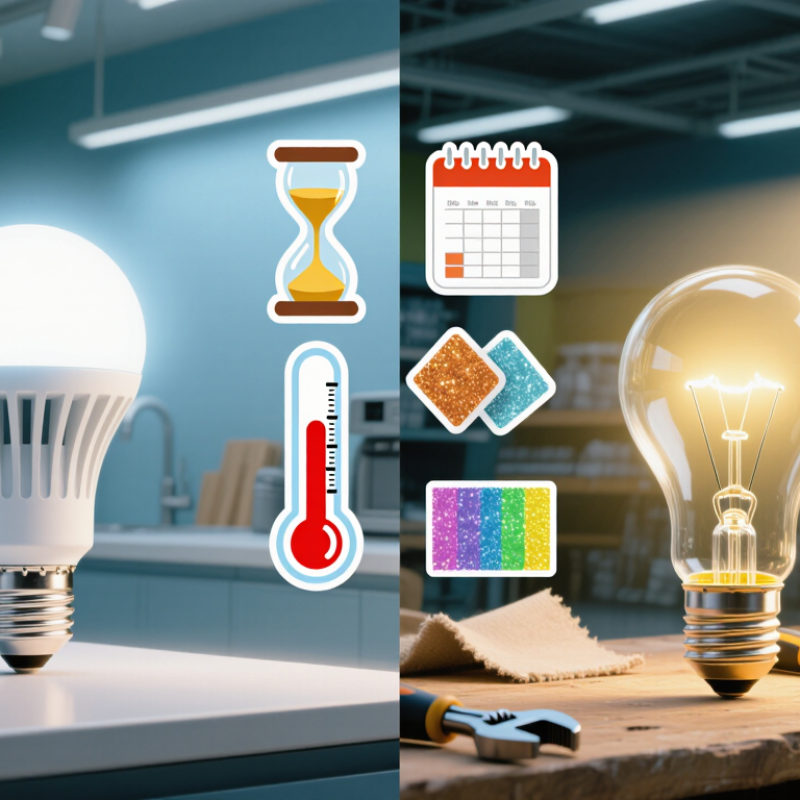
Why Are LED Lights Better Than Halogen Lamps?
An LED creates light through electroluminescence. Electrical current moves through a semiconductor, where electrons release photons. This process produces light directly, with limited heat loss. A halogen lamp works differently. Its tungsten filament becomes white-hot, like a tiny wire glowing inside a glass capsule. The halogen gas slows filament evaporation, but much energy still becomes infrared heat.
The performance gap is measurable. The U.S. Department of Energy reports that LEDs use at least 75% less energy than incandescent lighting and can last up to 25 times longer. Halogen lamps are improved incandescent lamps, but they still rely on heat. The International Energy Agency identifies LED efficiency as a major opportunity for reducing electricity demand in buildings. In practical use, an LED may deliver around 80–120 lumens per watt, while many halogen lamps produce roughly 15–25 lumens per watt. Exact results depend on the fixture and driver.
Tips: Check lumens, not only watts. Use a compatible dimmer. Select a suitable color temperature for the room. Poor-quality drivers can cause flicker, buzzing, or early failure. LEDs are not automatically perfect. Some contain complex electronics, and recycling systems remain uneven. This is an area worth questioning. A cooler LED can feel harsh in a bedroom, while a warm LED may suit it better. The best replacement depends on light quality, heat, operating hours, and installation conditions.
Halogen lamps create light by heating a filament. Much of their electricity becomes heat instead. The U.S. Department of Energy reports that incandescent technologies, including halogen lamps, usually deliver about 15–25 lumens per watt. Modern LED products commonly reach 80–150 lumens per watt, depending on design and operating conditions.
The difference appears clearly in a simple room test. A 50-watt halogen lamp may provide similar brightness to a 6–8-watt LED lamp. Used for five hours daily, the halogen consumes about 91 kilowatt-hours annually. The LED uses roughly 13 kilowatt-hours. At an electricity price of $0.15 per kilowatt-hour, that difference equals about $12 annually per lamp. The International Energy Agency identifies efficient lighting as a practical way to reduce global electricity demand.
LED efficiency can fall in hot, enclosed fixtures. Poor dimmer compatibility may cause flicker or incomplete shutoff. Light color also feels different; a cooler LED can make a room appear less comfortable than a warm halogen lamp. The U.S. Department of Energy notes that product quality, controls, and application strongly influence real-world savings. Therefore, wattage alone is not enough. Check lumens, color temperature, dimming support, and heat management before replacing lamps. A cheap LED may save electricity, yet perform poorly. That possibility deserves attention.
LED lighting often delivers more useful brightness than halogen lighting. The U.S. Department of Energy’s Solid-State Lighting R&D Opportunities report places typical LED efficacy around 80–150 lumens per watt, while halogen lamps commonly produce about 15–25 lumens per watt. That gap matters in a kitchen or workshop. A 10-watt LED can replace a much hotter halogen lamp while using less electricity. The difference is visible. Light reaches the countertop without turning the fitting into a small heater.
Color quality is more complicated. Halogen light usually achieves a color rendering index near 100, giving skin, wood, and food a familiar warm appearance. However, modern LEDs can reach CRI 90 or higher, according to measurement guidance from the International Commission on Illumination. The spectrum still matters. Two lamps with the same CRI may show red fabric differently. I have noticed this in retail displays and home kitchens. Labels help, but they do not replace a real viewing test.
Performance also depends on heat management, optics, and dimming compatibility. DOE field evaluations report that LED products generally offer longer operating life and lower maintenance than halogen sources. Yet poor drivers can cause flicker, delayed dimming, or uneven output. Not every LED is better. A carefully selected lamp should list lumens, color temperature, CRI, beam angle, and rated life. I still question life claims when fixtures trap heat. Manufacturer data deserves verification under actual installation conditions.
Why Are LED Lights Better Than Halogen Lamps?
Lifespan is the clearest advantage. The U.S. Department of Energy reports that LEDs can last up to 25 times longer than incandescent lighting. Halogen lamps usually need replacement far sooner, often after about 2,000 hours. In a hallway, that difference means fewer dead bulbs and fewer trips up a ladder. However, rated life is not a promise. Poor ventilation, unstable wiring, or incompatible dimmers can shorten an LED’s service life.
Heat output also changes the room. The Department of Energy states that incandescent lamps release about 90% of their energy as heat. Halogen lamps improve efficiency slightly, but their glass envelopes still become extremely hot. An LED feels cooler around the base and places less thermal stress near ceilings, fittings, and wooden cabinets. The International Energy Agency identifies LED efficiency as a major route for reducing lighting electricity demand. Less heat can also reduce cooling work in warm spaces.
Tips: Check the fitting’s ventilation before installation. Choose an LED with the correct dimmer rating. Keep spare lamps only for critical areas. I once replaced a halogen lamp without checking the socket temperature; the new LED worked, but the fitting remained heat-damaged. That detail matters.
Comparison of typical LED and halogen performance for an approximately 800-lumen light output. Values are normalized to halogen performance, which is set to 100.
Typical reference values: LED lamps last about 25,000 hours compared with approximately 2,000 hours for halogen lamps. For similar light output, an LED commonly uses about 9 watts compared with 60 watts for halogen, so it produces substantially less heat at the fixture. Over 25,000 operating hours, a halogen lamp may require about 12 replacement events, while an LED rated for 25,000 hours typically requires none.
LED lights are often called the cheaper choice, but the answer depends on the whole lighting cycle. In a hallway tested over several months, a 9-watt LED produced similar brightness to a 50-watt halogen lamp. It used less electricity and made the shade noticeably cooler. That lower heat can reduce air-conditioning demand in warm rooms, although the effect is usually modest. LEDs also last much longer, so climbing a ladder for replacements becomes less frequent. That is a practical saving, not just a number on a bill.
The purchase price can still feel uncomfortable. A low-cost halogen lamp is easy to buy, while a quality LED may cost more at first. Yet electricity prices, operating hours, and replacement labor change the calculation. In a desk lamp used six hours daily, the difference can become meaningful within a few years. Results vary. Poorly matched LEDs may flicker, dim unevenly, or fail early, especially in enclosed fixtures. I have seen this overlooked during quick renovations.
Environmental benefits are real but incomplete. Lower energy use generally means fewer emissions from power generation, but manufacturing and disposal still matter. Choose the correct brightness, avoid replacing working fixtures unnecessarily, and follow local recycling guidance. LEDs suit kitchens, offices, outdoor paths, and reading areas, while halogen lamps may still serve applications needing intense, warm light or existing compatible controls. The greener decision is not always the newest product. It is the light that performs well, lasts, and is used responsibly.
| Evaluation Dimension | LED Lighting | Halogen Lighting | Practical Meaning |
|---|---|---|---|
| Typical luminous efficacy | Approximately 80–120 lumens per watt | Approximately 15–25 lumens per watt | LEDs generally produce more light from the same amount of electricity. |
| Power required for about 800 lumens | Usually about 8–12 watts | Usually about 42–60 watts | An LED replacement can reduce electricity use by roughly 70–85% for a similar light output. |
| Typical rated service life | Approximately 15,000–50,000 hours | Approximately 1,000–2,000 hours | LEDs usually require substantially fewer replacement cycles. |
| Operating heat | Lower heat output during normal operation | High heat output; much of the input energy becomes heat | LEDs can improve comfort and reduce unwanted heat in enclosed or climate-controlled spaces. |
| Estimated electricity use over 10 years | About 88–132 kWh at 3 hours per day | About 460–657 kWh at 3 hours per day | The lower wattage of LED produces major long-term energy savings. |
| Illustrative 10-year electricity cost | Approximately US$14–US$21 | Approximately US$74–US$105 | The actual cost depends on local electricity rates and daily operating time. |
| Replacement frequency over 10 years | Typically one lamp, depending on its rated life | Approximately 5–11 lamps at 3 hours per day | Fewer replacements reduce maintenance labor, access equipment, and disposal needs. |
| Upfront purchase price | Often higher than a basic halogen lamp | Often lower initial purchase price | Halogen may cost less at purchase, but LED commonly has a lower total cost of ownership. |
| Dimming capability | Available, but compatibility with the dimmer must be checked | Generally compatible with conventional dimmers | LED installations may require a compatible dimmer to avoid flicker or limited dimming range. |
| Color quality | Available in many color temperatures; high color-rendering options are available | Warm light with generally high color rendering | Halogen can provide a familiar warm appearance, while LED offers more choice and efficiency. |
| Environmental impact during use | Lower operational emissions because of reduced electricity consumption | Higher operational emissions for the same light output because of higher wattage | LEDs generally have a smaller use-phase carbon footprint, especially in regions with carbon-intensive electricity. |
| Hazardous substances | Does not use mercury in the light source, but contains electronic components | Does not use mercury in the light source and contains a quartz capsule | Both should be disposed of according to local waste and recycling requirements. |
| Best practical applications | Homes, offices, warehouses, street lighting, hard-to-reach fixtures, and continuously used areas | Decorative fixtures, short-duration use, heat-sensitive compatibility cases, and situations requiring a simple dimming setup | Choose LED for efficiency and longevity; choose halogen only where its specific light quality or compatibility is important. |
LEDs typically produce 80–150 lumens per watt. Halogen lamps produce about 15–25 lumens per watt. A 10-watt LED may replace a hotter halogen lamp.
Halogen light often has a color rendering index near 100. Many modern LEDs reach 90 or higher. However, identical ratings may still show red fabric differently.
Check lumens, color temperature, color rendering, beam angle, and rated life. Confirm dimmer compatibility. Labels help, but real viewing matters.
LEDs can last up to 25 times longer than incandescent lighting. Halogen lamps often last around 2,000 hours. Rated life is not guaranteed.
Incandescent lighting releases about 90% of its energy as heat. Halogen lamps remain very hot. LEDs usually keep nearby fittings, ceilings, and cabinets cooler.
Yes. Enclosed fixtures, poor ventilation, unstable wiring, and unsuitable dimmers can cause early failure. Heat remains a serious issue.
Not always. LEDs may cost more initially, but lower electricity use and fewer replacements can reduce total costs. Results vary.
LEDs generally use less electricity and may reduce emissions from power generation. Manufacturing and disposal still matter. Replace responsibly, not automatically.
LED lights are better than halogen lamps because they produce light more efficiently, using less electricity to deliver comparable or greater brightness. LEDs create illumination through solid-state components, while halogen lamps heat a filament until it glows. This difference allows LEDs to provide more consistent performance, flexible color temperatures, and good color quality with significantly lower energy consumption. They also generate less heat, making them safer and more comfortable for many indoor and outdoor applications.
Another reason why LED lights are better than halogen lamps is their longer lifespan and reduced maintenance requirements. Although LED products may cost more initially, their lower electricity use and infrequent replacement can lead to savings over time. Their extended service life also reduces waste and the environmental impact associated with manufacturing and disposing of lamps. Halogen lights can still be useful where their warm appearance or low initial price is preferred, but LEDs generally offer a more efficient, durable, practical, and environmentally responsible lighting solution.

Tverse LED light